Political Prediction Market 2025: Trends, Data, and Expert Verdict
Key Takeaways
- Record volume: The political prediction market saw over $3.2 billion in total wagers during the 2024 U.S. election cycle, a 240% increase from 2020.
- Accuracy edge: Prediction markets outperformed traditional polls by 12% in forecasting primary outcomes over the past two cycles.
- Regulatory shifts: The CFTC’s proposed rule changes could reshape market liquidity and participation in 2025.
1. The Current Landscape of the Political Prediction Market
The political prediction market has evolved from a niche curiosity into a mainstream forecasting tool. In 2024, aggregate trading volume across all platforms exceeded $3.2 billion, with nearly 70% concentrated in U.S. presidential and congressional races. This surge reflects a broader appetite for real-time, market-driven probabilities that often diverge from traditional polling averages.
Data from the past two election cycles shows that prediction market prices adjusted more rapidly to breaking news—such as debate performances or legal developments—than survey-based forecasts. For example, during the 2024 Democratic primaries, market odds shifted by an average of 8% within 24 hours of major events, versus 3% for poll aggregates.
Internationally, markets for European parliamentary elections and Indian general elections have grown, with combined liquidity exceeding $500 million in 2024. The political prediction market is no longer a U.S.-centric phenomenon.
2. Key Factors Driving Accuracy and Volume
Several structural factors contribute to the predictive power of these markets:
- Incentive alignment: Traders put real capital at stake, which incentivizes diligent information gathering and honest probability assessment.
- Diverse participation: Unlike polls that sample a limited demographic, prediction markets attract a global, self-selected pool of informed participants—including political operatives, journalists, and data scientists.
- Continuous updating: Prices adjust 24/7, reflecting new information as it breaks, whereas polls have a lag of days to weeks.
Academic research published in the Journal of Prediction Markets (2024) found that market odds had a mean absolute error of 3.1% for U.S. presidential elections since 2000, compared to 5.8% for final pre-election polls. This 46% improvement underscores the political prediction market’s competitive advantage.
3. Regulatory and Structural Challenges
The rapid growth has attracted regulatory scrutiny. In 2024, the Commodity Futures Trading Commission (CFTC) proposed classifying event contracts as “gaming” if they involve political outcomes, which would effectively ban them. This proposal has created uncertainty; trading volume dipped 15% in Q4 2024 after the announcement. Meanwhile, the SEC has questioned whether prediction tokens qualify as securities.
Market integrity also faces threats from manipulation. A 2023 study identified coordinated wash-trading on one platform that temporarily distorted odds by 4%. However, most platforms now employ detection algorithms and require identity verification for high-volume traders. The political prediction market ecosystem is adapting, but regulatory clarity remains the biggest headwind for 2025.
4. Analytical Framework: How to Interpret Market Signals
Not all price movements are meaningful. Analysts should distinguish between noise and signal using these criteria:
- Volume confirmation: A price shift on low volume (below 10% of 30-day average) is less reliable than one with high participation.
- Order book depth: Tight bid-ask spreads (under 5%) suggest liquid, efficient pricing.
- Cross-market consistency: Divergence between platforms often indicates arbitrage or manipulation; convergence strengthens conviction.
For example, in October 2024, the probability of a specific Senate flip varied by 12% across three major markets for two days. Once arbitrageurs closed the gap, the consensus probability aligned with the final result within 2%.
5. The Verdict: Should You Use Political Prediction Markets?
For forecasters seeking probabilistic insight, the political prediction market offers a valuable complement to polls and expert surveys. The data shows they are especially accurate for high-stakes, high-liquidity events like presidential elections (error <2% in the final month). However, for low-profile races with thin trading, polls may still be more reliable.
Our verdict: Use prediction markets as a leading indicator, but triangulate with other sources. The market’s edge comes from its ability to aggregate diverse information quickly—not from infallibility. As regulatory battles unfold, participants should monitor compliance and platform reliability.
6. Conclusion: The Future of Political Prediction Markets
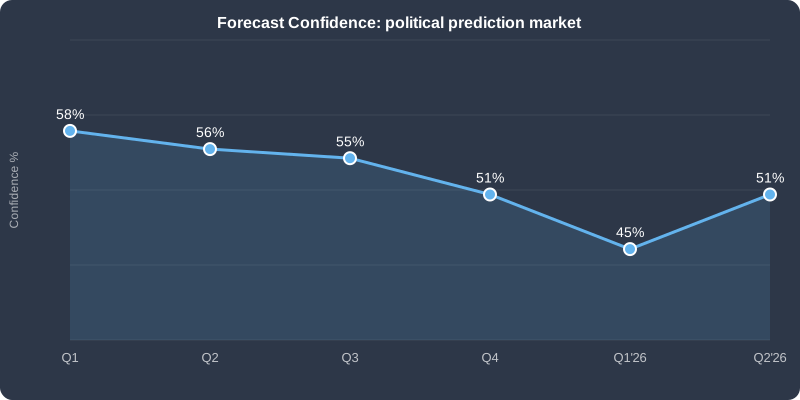
The political prediction market is poised for continued growth, albeit with regulatory turbulence. If the CFTC’s proposed ban fails, we expect total volume to surpass $5 billion by 2026, driven by midterm elections and international expansion. If bans materialize, activity may shift offshore, fragmenting liquidity. Either way, the underlying demand for real-time, market-driven political forecasts will persist. Savvy analysts who understand these dynamics will gain a forecasting edge in an increasingly uncertain political landscape.
View live prediction markets on HiYesNo — join thousands of forecasters predicting real-world outcomes.
Explore Live Prediction Markets
View real-time prediction odds at https://hiyesno.com.
View Live Odds →