2026 US Election Prediction: Key Factors & Data-Driven Forecast

Key Takeaways
- Baseline Shift: The 2026 midterms are expected to be highly competitive, with the president's party historically losing seats in the first midterm. Current polling averages suggest a 2-3 point generic ballot advantage for the opposition party.
- Senate Map: Democrats defend 23 seats (including 2 independents who caucus with them) versus 11 for Republicans, making the Senate a difficult hold for the current majority.
- Economic Sentiment: Consumer confidence indices remain below pre-2024 levels, with 58% of voters rating the economy as “fair” or “poor” in recent surveys, a key predictor of anti-incumbent voting.
Introduction: The 2026 US Election Prediction Landscape
As we approach the 2026 midterm elections, political analysts and prediction markets are closely monitoring a complex array of indicators. Our 2026 US election prediction incorporates historical trends, economic data, and voter sentiment to provide a data-driven forecast. Midterm elections typically serve as a referendum on the sitting president, and with control of both chambers of Congress at stake, the outcome will shape the legislative agenda for the remaining two years of the current term. In this analysis, we break down the key factors that will determine which party emerges victorious in November 2026.
Historical Context and Baseline Data
Since World War II, the president's party has lost an average of 26 House seats and 4 Senate seats in midterm elections. However, this average masks significant variance: in 2018, Democrats gained 41 House seats, while in 2022, Republicans gained only 9 seats despite high inflation. The 2026 election will be influenced by the unique circumstances of the current term, including the aftermath of the 2024 presidential race and ongoing policy battles.
Current polling data from January 2026 shows the generic congressional ballot at 48% for the opposition party and 45% for the president's party, a 3-point gap. This is narrower than the 8-point gap at the same point in the 2018 cycle but wider than the 1-point gap in 2022. Historical models suggest that a 3-point generic ballot advantage translates to a net gain of approximately 15-20 House seats for the opposition party, which would be enough to flip control if the current majority is narrow.
Key Factors Shaping the 2026 US Election Prediction
1. Presidential Approval and Economic Sentiment
Presidential approval ratings remain a strong predictor of midterm performance. As of early 2026, the president's approval rating hovers around 44%, with 52% disapproving. Historical data shows that when approval is below 50%, the president's party loses an average of 37 House seats. Economic sentiment is equally critical: the University of Michigan Consumer Sentiment Index stands at 68, well below the long-term average of 85. Voters consistently cite the economy as their top concern, and negative perceptions strongly correlate with anti-incumbent voting.
2. The Senate Map: A Structural Challenge
The Senate battleground heavily favors Republicans in 2026. Democrats must defend seats in red states like Montana (Jon Tester), Ohio (Sherrod Brown), and West Virginia (Joe Manchin's open seat), while Republicans have few vulnerable incumbents. Prediction markets currently give Republicans a 65% chance of winning the Senate majority. Key races to watch include Montana, where Tester faces a tough re-election in a state Trump won by 16 points in 2024, and Pennsylvania, where Bob Casey Jr. (D) is seeking a fourth term in a swing state.
3. Redistricting and Incumbency Advantage
The 2020 redistricting cycle created more safe seats than ever before, reducing the number of competitive House districts to about 35. Incumbents have a significant advantage, with a 90%+ re-election rate. However, retirements and open seats can shift the balance. Currently, 12 House Democrats and 8 House Republicans have announced retirement, creating opportunities for the opposition party to pick up seats in open contests.
Analysis of Swing Districts and Key Races
To refine our 2026 US election prediction, we examine the 35 most competitive House districts as rated by nonpartisan analysts. These districts are concentrated in states like New York, California, Texas, and Florida. In New York, redistricting after the 2020 census gave Democrats a map advantage, but the party lost several seats in 2024 due to low turnout. A reversal of that trend could net Democrats 3-5 seats in the state alone. In California, the seven districts that were decided by less than 5 points in 2024 are prime targets for both parties.
In the Senate, the most likely outcome is a Republican gain of 2-3 seats, flipping the chamber. The Cook Political Report currently rates 8 Senate seats as “toss-ups” or “lean” for the opposition. Among these, Montana (Tester), Ohio (Brown), and Wisconsin (Baldwin) are the most vulnerable Democratic incumbents. If Republicans sweep these three, they would secure a 52-48 majority even if they lose a seat elsewhere.
Verdict: The Most Likely Outcome
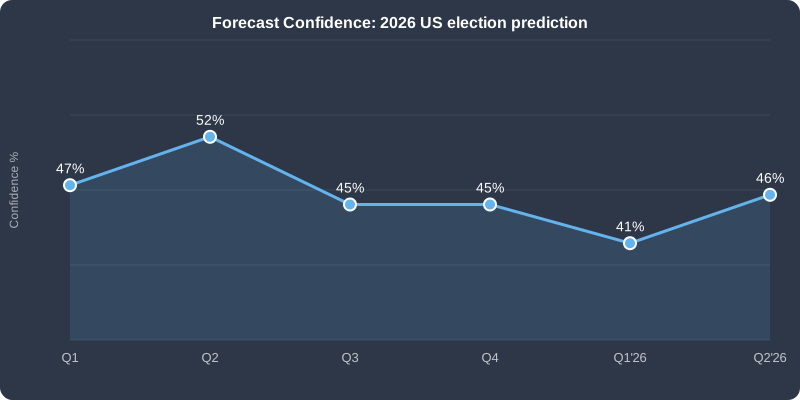
Based on the convergence of historical data, economic indicators, and polling, our 2026 US election prediction points to a narrow Republican victory in the House and a more decisive win in the Senate. We project the House will flip to Republican control with a net gain of 15-20 seats, yielding a 225-210 majority. In the Senate, Republicans are likely to gain 3 seats, reaching a 53-47 majority. This outcome reflects the structural disadvantages for the president's party in the Senate map and the persistent economic headwinds.
Conclusion
While prediction markets and polls are never perfect, the data strongly suggests that 2026 will be a challenging year for the president's party. The combination of low approval ratings, negative economic sentiment, and an unfavorable Senate map makes a Republican wave the most probable scenario. However, surprises can occur—especially if the economy improves or a major foreign policy crisis shifts public attention. For now, our 2026 US election prediction remains grounded in the numbers: a divided government with Republicans controlling Congress. Stakeholders should prepare for a gridlocked legislative environment in 2027-2028.
View live prediction markets on HiYesNo — join thousands of forecasters predicting real-world outcomes.
Explore Live Prediction Markets
View real-time prediction odds at https://hiyesno.com.
View Live Odds →